What is the NCAA 10/7 Rule?
Updated on Nov 20, 2026

Did you know there are additional eligibility rules required to compete at the NCAA Division I (DI) level that other NCAA divisions and governing bodies (NAIA and junior colleges) do not require?
One of these additional eligibility rules is the core-course progression requirement, also known as the “10/7 Rule” or “10/7 Lock” – and it is one of the only NCAA initial-eligibility rules that has a hard and fast deadline. If a student-athlete does not meet the 10/7 Rule by the mandatory deadline, they will be ineligible to play at a DI school right after high school.
Let’s plan ahead and dive into the complexities of the 10/7 Rule.
NCAA initial-eligibility rules require college-bound student-athletes looking to compete at a DI or Division II (DII) school to complete 16 NCAA-approved Core Courses at their high school(s) by the time they enter college. However, for students looking to compete at the DI level, the NCAA requires 10 of those 16 core courses to be completed by the start of the student’s 7th semester of high school – meaning time is up once they begin their senior year of high school. Specifically, 7 of those 10 courses MUST be in the subject areas of English, Math, or Natural/Physical Science.
Before senior year, students can repeat a core course to improve the grade, and the NCAA Eligibility Center will use the best combination of courses completed before the seventh semester. Once senior year starts, any course needed to meet the 10/7 requirement is “locked in.” It can’t be replaced or repeated, including by a course taken after graduation. Students with more than 10 qualifying courses have more flexibility, because a course not needed for 10/7 can still be repeated.
Honest Insight: For current juniors in high school, it is extremely important to keep track of core course count, since they may need to utilize the summer term between junior and senior years to meet the deadline.
Exception to the rule is that students with solely international academic credentials (including Canada) are not required to meet the 10/7 requirement.
Do Online Courses Count Towards the NCAA 10/7 Requirement?
If a school does not offer NCAA-approved courses in the summer, students may take NCAA-approved courses with a virtual school. Sometimes online courses are the only option that exists if a student hasn’t taken the required number of NCAA-approved course offerings during their first 3 years of high school.
Since August 2024, the NCAA no longer uses a separate set of rules for online or nontraditional courses. An online course counts the same way as any other core course:
- The course must meet all requirements for an NCAA-approved core course.
- The course must be on the NCAA-approved core-course list for the school or program that offers it.
- It must be listed under the exact title shown on the transcript (for example, “English 1 ONL”).
- Credit-recovery and repeated courses can also count, but they must be substantially comparable to the original course.
The virtual courses need not count toward a student’s school graduation credits; however, the virtual school transcript must be submitted separately to the NCAA Eligibility Center. If a student would like their online course to apply towards their graduation credit, they will need to get approval from their high school.
Several schools offer NCAA-approved courses. These online schools don’t have to be affiliated with your high school to get you NCAA credit.
Honest Insight: Before enrolling, look up the online school on the NCAA’s high school course list (eligibilitycenter.org/courselist). Confirm the exact course title is approved and fills the subject area you need, and make sure the online school will upload its official transcript to your Eligibility Center account.
Know Your NCAA 10/7 Status
To simplify the eligibility process, Honest Game’s CARE® (College Athletic Report on Eligibility®) provides an individualized report that includes an NCAA GPA calculator, NCAA credit tracking, and a clear view of a student-athlete’s academic eligibility status, as well as their NCAA 10/7 progression.
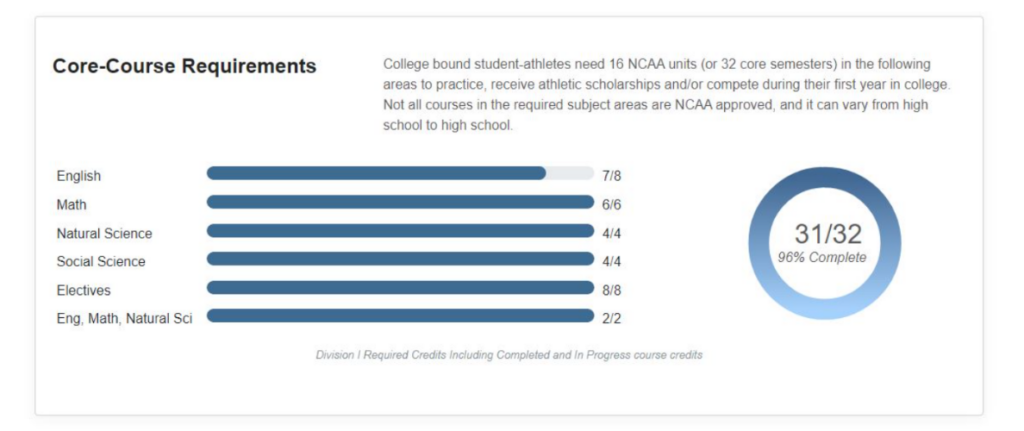
CARE® also provides strategic advice on any core course deficiencies and when they need to be completed before the NCAA clock runs out.
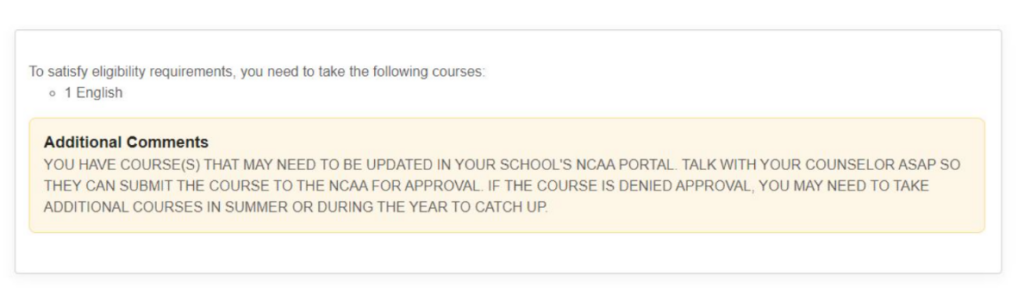
CARE® is downloadable and easy to share with parents/guardians, high school administrators and college recruiters to make sure everyone is on the same page before it’s too late.
Have more questions about the NCAA academic eligibility process? Honest Game Counselors are here to help navigate course selection and schedule planning to ensure student-athletes are on track to be academically eligible for college sports. Schedule a time to meet virtually with our experts.
 By Courtney Rickard, Honest Game Director of Academics and Compliance
As a former Senior Associate Athletic Director at the NCAA Division I level and with more than 20 years of experience in collegiate athletics, Courtney has advised thousands of student-athletes through the college recruiting and eligibility process for college sports. Interested in virtual counseling with Courtney? Sign up here.